Check for Updates
The Check for Updates community module tells administrators, on the GeoServer landing page, when the GeoServer they are running needs attention. It reads a small JSON feed that is published in the GeoServer GitHub repository, and reports:
- a newer patch release in the running series
- that the running series has moved to maintenance, or is no longer supported
- a newer release that the geoserver.org/blog announcement marks as a security release, or that came out together with other series, which usually means a security release
- a published security advisory that applies to the running version
The module only ever downloads the feed. It never reports the running version or anything else about the GeoServer it is installed on. The
feed is a static file on GitHub, downloaded from raw.githubusercontent.com (see Feed URL below for an alternative
host). The GeoServer team does not run these hosts, receives no request logs at all and cannot see which GeoServer
versions are running. The download is an ordinary web request, so the feed host can see the public IP address of the
server making it.
Installation
As a community module, the package needs to be downloaded from the nightly
builds - search for updates-checker-plugin.zip.
Unpack the zip file contents into GeoServer's WEB-INF/lib directory and restart GeoServer.
Note
The module is compiled for Java 11, so the same JAR can be copied into any GeoServer from version 2.23 onwards, including a server that is already running in production, without rebuilding it.
Installing with Docker
To run the GeoServer Docker image with the module installed, pass it as a community extension:
3.1.0 example:
docker run -it -p 8080:8080 \
  --env INSTALL_EXTENSIONS=true \
  --env COMMUNITY_EXTENSIONS="updates-checker" \
  docker.osgeo.org/geoserver:3.1.0
When the feed is checked
The feed is fetched at most once per administrator session, plus once at server startup and whenever Check Now or the REST endpoint is used. There is no timer.
- First view of a session: the first time an administrator opens the landing page, the page loads at once and the feed is fetched in the background. The banner appears in place a moment later.
- Later views in the same session: the banner is drawn from what the server already holds, with no new download.
- Startup: a short background thread makes one download, so an unreachable feed can never delay server startup.
- A failed download is not retried. The last good copy is kept and used.
Only full administrators (holders of the ROLE_ADMINISTRATOR role) see the banner or trigger a download. Workspace administrators and other users do not.
Configuring
Once installed, the module adds a Check for Updates page under the About & Status (GeoServer 2) or GeoServer (GeoServer 3) menu.
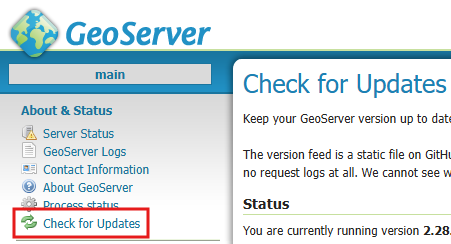
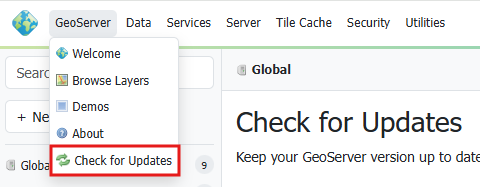
Below the Status section are these settings:
- Feed URL - where the feed is fetched from. Read-only in the GUI. To use a different feed, for
example an internal mirror, set the
UPDATES_CHECKER_FEED_URLapplication property as a Java system property (-DUPDATES_CHECKER_FEED_URL=https://raw.githubusercontent.com/geoserver/geoserver/updates-checker-v1/versions.json), a web application context parameter, or an environment variable. Ifraw.githubusercontent.com/is blocked by your organisation, try the jsDelivr copy of the default feed:https://cdn.jsdelivr.net/gh/geoserver/geoserver@updates-checker-v1/versions.json. - Suppressed advisories - read-only, empty by default. The security advisories (CVE or GHSA ids) that the server administrator has mitigated and does not want reported. They are set outside GeoServer, see Suppressing mitigated advisories.
- Enable update check at login and startup - on by default. When off, only Check Now and the REST endpoint work.
- Write check results to logs - on by default. Writes one line to the GeoServer log for each check (at startup, on the first view of a session and on Check Now) with the result and the versions. Failures to download or read the feed are always logged at WARN, whatever this setting says.
- Hide version numbers in logs - off by default. Leaves version numbers out of the per-check result lines. The banner and the Status section always show them, and failure lines are not affected.
The settings are saved in updates-checker/updates-checker.xml in the data directory.
Feed
The feed is built every 15 minutes by the Updates Checker feed workflow, from these public sources:
geoserver/geoserver/security/advisoriesgeoserver/geoserver/releasesgeoserver/geoserver.github.io/_posts
The generator and its tests are in .github/workflows/updates-checker/. The result is committed to the
updates-checker-v1 branch and published at:
- https://raw.githubusercontent.com/geoserver/geoserver/updates-checker-v1/versions.json
- https://cdn.jsdelivr.net/gh/geoserver/geoserver@updates-checker-v1/versions.json (for networks that block
raw.githubusercontent.com)
Notifications
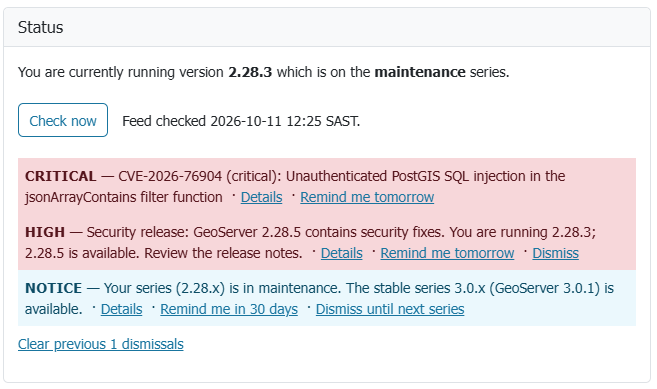
When several notifications apply, the banner shows the most important one and a link "N more notices" to the Check for Updates page. Order is by severity, and within one severity security notices come first, then patches, then series notices.
| Notification | Severity | Meaning | Actions |
|---|---|---|---|
| Confirmed security advisory | CRITICAL, HIGH, WARN or INFO, as per the advisory | An advisory applies to the running version | CRITICAL: Remind me tomorrow. Others: Dismiss |
| Advisory could not be checked | As per the advisory | The advisory's version range could not be read, so it needs a manual look | Dismiss |
| Security release | HIGH when announced as a security release, WARN when only released together with other series | A release newer than the running version, in the running series, is a security release or probably one. The notice names that release and the version to upgrade to, and its Details link is the announcement. It replaces the newer patch notice | Remind me tomorrow, Dismiss |
| Newer patch | WARN | A newer patch exists in the running series | Remind me tomorrow, Dismiss for version X.Y.Z |
| Series in maintenance | NOTICE | A newer stable series exists | Remind me in 30 days, Dismiss until next series |
| Series unsupported | WARN | The series is beyond community support, or too old for the feed to cover | none, always shown |
| Feed unavailable | WARN | The feed could not be downloaded and there is no earlier copy | none |
| Feed schema too new | WARN | The feed is newer than this module understands: update the module | none |
| Version unknown | INFO | The running version could not be determined, so no check is made | Dismiss (this session) |
The feed names the releases of the last 365 days, so a security release older than that is no longer named; the advisories still apply.
A SNAPSHOT, release candidate or milestone build is not compared with released versions, and has no advisories or updates to report. It still reports a feed that is unavailable or too new.
An advisory applies to a version unless that version is at or beyond the first patched version of its own series. An advisory whose version range cannot be read is never ignored; it is shown for manual review instead.
Dismissing notifications
Dismissals are stored in the administrator's own browser (localStorage), not on the server. A dismissal stops applying as soon as a newer version, series or advisory is involved, so
it never silently hides a later one. A CRITICAL confirmed advisory can only be snoozed for a day, never dismissed for
good.
Because the choice lives in the browser, it applies to that browser and that address only: an administrator on another device, under another host name, or in a private window sees the notifications again.
Suppressing mitigated advisories
If you have mitigated a security advisory without upgrading, for example with a firewall rule or by disabling the
affected service, you can stop the module reporting it. Set the UPDATES_CHECKER_SUPPRESSED_CVES application
property to the ids, separated by commas, semicolons or spaces, as a Java system property
(-DUPDATES_CHECKER_SUPPRESSED_CVES="CVE-2026-76904,GHSA-aaaa-bbbb-cccc"), a web application context parameter, or an
environment variable. Both CVE and GHSA ids are accepted, in any case; entries that are not ids are ignored, and at most 100 are used.
Because the property belongs to whoever starts the server, a GeoServer administrator cannot change it from the web interface. The Suppressed advisories box on the settings page only shows it.
- A suppressed advisory is left out of the banner, the Status section and the REST response, and no longer makes the check report an update.
- The Status section says that advisories are suppressed and names the ones that apply to your version, so a suppression is never invisible.
- GeoServer writes one WARN line at startup naming the suppressed advisories. Each check line then ends with the number
suppressed, for example
(1 suppressed), without the ids. - Only advisories are affected. A newer release that was announced as a security release is still reported, because the feed does not say which advisories a release fixes.
Status and Check Now
The Status section on this page shows what GeoServer version is running, when the feed was last checked, and every active notification. It is filled from the server's copy when the page opens. The notifications have the same actions as the Welcome page banner, and the ones dismissed in this browser are hidden. The link "Clear previous N dismissals" at the bottom brings them back.
Check Now downloads the feed straight away and refreshes the Status section.
REST endpoint
POST /rest/updates-checker/check performs the same check as Check Now (so it downloads the feed every time) and returns the result as JSON:
{
  "status": "URGENT_UPDATE_AVAILABLE",
  "message": "CVE-2026-76904 (critical): Unauthenticated PostGIS SQL injection",
  "installedVersion": "2.27.0",
  "newerVersion": "2.27.6",
  "error": null,
  "suppressed": [],
  "suppressedBy": null,
  "notifications": [
    {
      "type": "CVE_CONFIRMED",
      "severity": "CRITICAL",
      "message": "CVE-2026-76904 (critical): Unauthenticated PostGIS SQL injection",
      "discriminator": "GHSA-jvpx-6qxg-whgc",
      "link": "https://github.com/geoserver/geoserver/security/advisories/GHSA-jvpx-6qxg-whgc"
    }
  ]
}
status is one of:
| Status | Meaning |
|---|---|
URGENT_UPDATE_AVAILABLE |
A critical or high security advisory applies to this version or could not be ruled out, or a newer release is a security release |
UPDATE_AVAILABLE |
Any other advisory, a newer patch, or a series beyond community support |
UP_TO_DATE |
Nothing needs action. A series in maintenance, or a development build, still reports this |
CHECK_FAILED |
The check could not tell: the feed could not be read, its schema is newer than the module understands, or the running version is unknown |
message is the most important notification, and notifications lists everything active, most important first.
suppressed lists the suppressed advisories that apply to this version, and suppressedBy is environment when the
server's list was used, request when the call supplied its own, and null when nothing was suppressed. Access is controlled by GeoServer's standard /rest
rules in security/rest.properties, which by default require the administrator role (ROLE_ADMINISTRATOR). Only POST is
accepted, and the response is always JSON.
Suppressing advisories in a request
The call accepts an optional JSON body. Its suppressedCves array replaces the server's list, but only for this call:
the banner, the Status section and later calls are not affected. Leave the body out, or leave out suppressedCves, to use
the server's list; an empty array suppresses nothing.
curl -u admin:YOUR_PASSWORD -X POST -H "Content-Type: application/json" \
     -d '{"suppressedCves": ["CVE-2026-76904"]}' \
     http://localhost:8080/geoserver/rest/updates-checker/check
A body that is not a JSON object, a suppressedCves that is not an array of CVE or GHSA ids, or a body over 64 KiB is refused with
HTTP 400.
Support
This module is maintained by GeoGuru.Africa. Questions, enhancements and issues can be sent to gs-updates-checker@geoguru.africa.